

Zone Zero: The First Five Feet That Decide Your Home's Odds
Living Ready in the Mountains
Zone Zero: The First Five Feet That Decide Your Home's Odds
A plain-English guide to ember-resistant landscaping, home hardening, and fire access for East County homeowners.
I have lived in these mountain communities for the better part of my adult life, and I come from a family that has spent careers on the fire line. So when I talk about wildfire preparedness, it is not theory. It is dinner table conversation. The good news I want to lead with is this: the single most powerful thing you can do for your home costs very little and sits within arm's reach of your front door.
It is called Zone Zero, and most homeowners I meet have never heard the term. Let's fix that.
What Zone Zero Really Is (And What It Is Not)
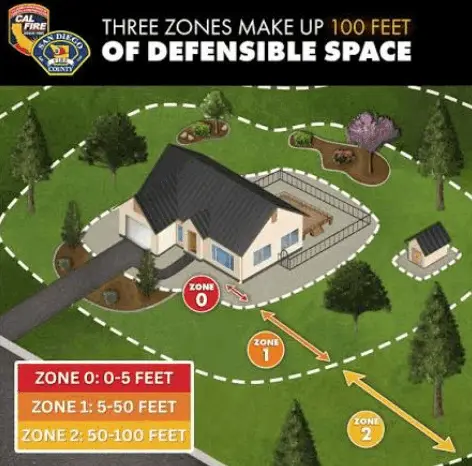
Zone Zero, sometimes called the ember-resistant zone, is the first five feet immediately surrounding your home and anything attached to it. That includes your deck, your steps, fences that touch the house, and the area tucked up under your eaves.
The whole job of this zone is simple: take away anything that can catch fire right next to the walls. We are talking about bark mulch, leafy shrubs pressed against the siding, the woodpile stacked by the back door, plastic storage bins, doormats, patio cushions, and the pile of dry leaves that always seems to collect in the corner.
Here is what Zone Zero is not, because the confusion is common:
- It is not simply clearing brush somewhere out on the back acre, far from the house. That matters too, but it is a different zone.
- It is not only about big trees. It is mostly about small, ordinary objects that quietly catch embers.
- It is not a one weekend project you finish and forget. It is a maintenance habit, like cleaning the gutters.
Zone Zero is not "zeroscape"
This is where people tense up, so let me put the worry to rest. Zone Zero does not mean zeroscape. It is not about tearing out every plant and pouring a sea of gravel until your yard looks like a parking lot in Phoenix. An Arizona style rock yard is not the goal, and honestly a neglected gravel lot still collects dead leaves and pine needles for embers to find.
The goal is a well maintained, cared for property. You can absolutely have a green, attractive, welcoming home. The difference is in the choices: low, well watered, well spaced plants instead of dense shrubs crowding the wall, tidy hardscape instead of bark mulch, and a perimeter you actually keep up through the season. Zone Zero rewards good housekeeping, not bare dirt.
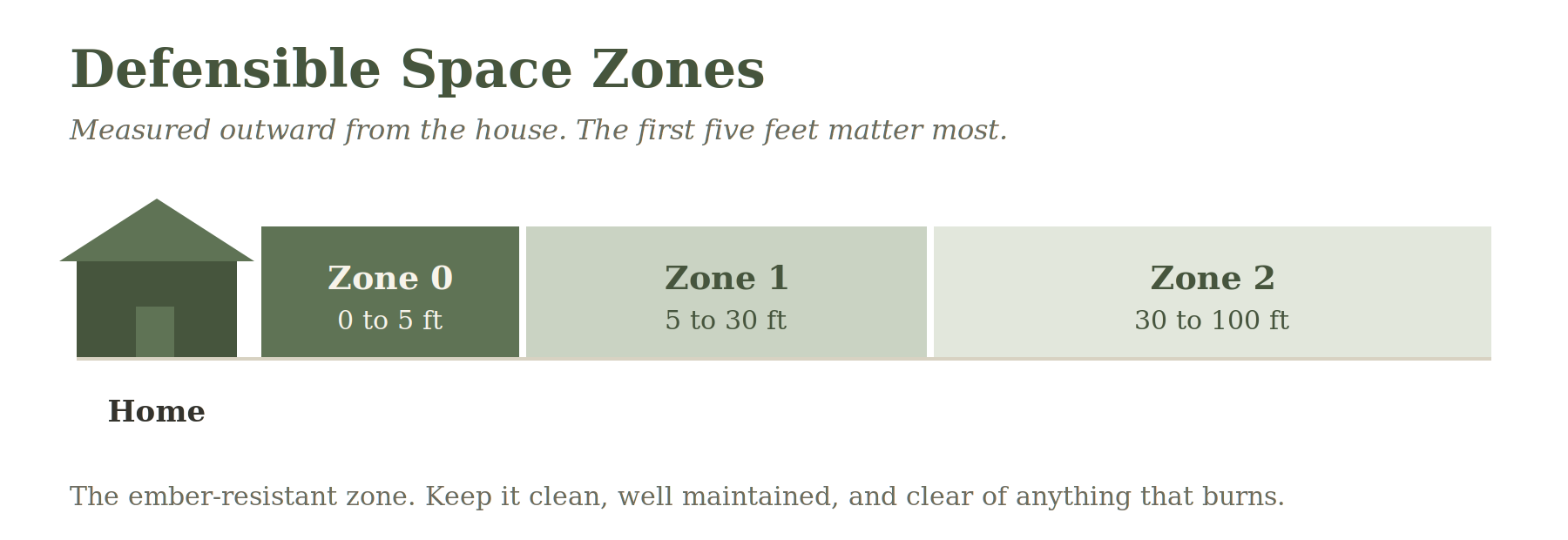
Why This Tiny Zone Matters So Much
Here is the part that surprises people. In most modern California wildfires, homes are not lost to a towering wall of flame rolling through the yard. They are lost to embers. Wind carries burning embers far ahead of the fire itself, often a mile or more, and they rain down on neighborhoods like a hot, glowing snowfall.
Those embers do not need a forest to do damage. They just need something small and dry to land on within a few feet of your house. A flammable doormat. A juniper hugging the foundation. Pine needles wedged in the deck boards. Once one of those catches, the fire has a foothold right against the structure, and now your home is the fuel.
This is exactly why Zone Zero is designed to give embers nothing to work with. Clear those first five feet and the ember shower has nowhere to take hold. It is one of the highest impact, lowest cost moves a homeowner can make, and it does not require a contractor or a permit. It requires an afternoon and a wheelbarrow.
In Zone Zero, lean toward:
- Bare soil, rock, gravel, or pavers in the first five feet
- Well watered, low growing plants kept small and spaced out, if any
- Metal, masonry, or other noncombustible borders
- A clean, swept perimeter checked through fire season
Move these out of Zone Zero:
- Bark or wood chip mulch against the house
- Shrubs, vines, and dead plants touching siding or windows
- Woodpiles, propane tanks, and stored lumber
- Plastic bins, doormats, cushions, brooms, and clutter
- Wood fences and gates that connect directly to the house
The Sunrise Powerlink Grant and Local Help
If you live near the Sunrise Powerlink transmission corridor, and many of our East County and mountain homeowners do, there is real money set aside to help you with this work. The Sunrise Powerlink Fire Mitigation Grant Program is funded by SDG&E and overseen by a group of local fire agencies, including Alpine Fire Protection District, Lakeside Fire Protection District, the San Diego County Fire Authority, CAL FIRE, and others.
In plain terms, eligible homeowners in the focused area near the line can apply for grants that help pay for defensible space and home hardening. Recent program years have offered grant categories for:
- Defensible space and vegetation work, including Zone Zero clean up
- Structure hardening, such as roofs, eaves, siding, windows, doors, and decks
- A priority track specifically for Zone Zero improvements
- A priority track specifically for ember-resistant vents
Eligibility areas, funding amounts, and deadlines change from year to year, and structure hardening grants generally require a permit with a passed final inspection. The best move is to look up your parcel on the official program map and read the current year's rules at sunrisepowerlinkgrants.com.
Beyond Sunrise Powerlink, California and San Diego County periodically offer other rebates and cost-share programs for fire-resistant vents, ignition-resistant materials, and defensible space help for low income, senior, and access-and-functional-needs homeowners. Your local fire protection district and the San Diego County Fire Authority are the right people to ask about what is open right now.
Vents: The Quiet Weak Point
Vents deserve their own section because they are the most overlooked vulnerability on the whole house. Your attic and crawlspace need to breathe, so they have openings. During an ember storm, those same openings can pull in embers and ignite your home from the inside out, while the outside still looks perfectly fine. Firefighters have watched it happen.
The fix is ember-resistant vents. At a minimum, California's wildfire building standards (Chapter 7A) call for vent screening made of noncombustible, corrosion-resistant metal mesh with openings no larger than one eighth of an inch. Newer construction increasingly requires purpose-built vents that are tested and listed by the California State Fire Marshal, because research has shown that embers can sometimes slip through plain mesh and still ignite fine material inside. Listed vents use baffles or heat-activated coatings to stop them.
Here is the encouraging part: swapping vents is one of the most manageable hardening projects there is. It is a fraction of the cost and disruption of a full remodel, it is exactly the kind of work the grant programs above will help fund, and it closes one of the largest doors an ember can walk through.
Driveways and Fire Access: The Reason Behind the Rules
Driveway requirements can feel like red tape until you understand where they come from. They are not arbitrary. They are built around what a fire engine, which can weigh well over thirty tons loaded, physically needs to reach your home, set up, and get back out safely.
In San Diego County, the access standards for homes in our high fire areas typically include:
- Width: a minimum of about 16 feet of unobstructed, improved width for a driveway serving one or two homes, with wider standards for shared roads
- Vertical clearance: at least 13 feet 6 inches overhead, which means trimming back the low branches and arbors that brush the top of a truck
- Grade: a maximum slope around 20 percent, with a deep broom concrete finish required on the steeper sections so heavy apparatus does not lose traction
- Turnarounds: a turnaround or hammerhead when a driveway runs longer than about 150 feet, so an engine never has to reverse blindly down a long, narrow drive
- Access and address: clearly visible, reflective address numbers, plus gates that open wide enough for apparatus, often with a Knox box so crews can get through a locked gate without losing time
Standards vary by district, so confirm the specifics with your local fire protection district. But the principle holds everywhere: every one of these rules exists to answer one question, which is whether a big engine can get to your home quickly, safely, and stay long enough to defend it.
What Actually Happens During a Wind-Driven Fire
I want to be honest with you about how a fast moving, wind-driven fire really unfolds, because understanding it makes everything above click into place.
When a fire is running with the wind, crews cannot be everywhere. They have to make quick decisions about where their limited engines and people will do the most good. This is called structure triage. As they move through a threatened neighborhood, they are sizing up each home in seconds and asking a practical question: can we safely defend this one, set up, and get out?
A home that is easy to reach, with clear access and a clean Zone Zero, is an easy yes. A home down a long, overgrown, single-lane drive with no turnaround, brush against the walls, and a woodpile on the deck is a much harder call, not because anyone wants to skip it, but because a crew cannot afford to get trapped. Think of it as your home making its case to the fire crew. You want it to be the obvious, low-risk yes.
The takeaway, crews defend the homes they can reach and work around safely. Access and Zone Zero are how you make your home one of them, long before a fire is ever on the ridge.
Putting It All Together
Zone Zero, hardened vents, defensible space, and good driveway access are not four separate chores. They are one system, and they work best together. The cleared perimeter denies embers a landing spot, the vents keep them out of the attic, the defensible space slows the fire's approach, and the access lets crews defend what you have protected.
If you do nothing else this season, do these three things:
- Walk the first five feet around your home and remove or replace anything that can burn.
- Look into the Sunrise Powerlink grant and other local programs to help pay for vents and hardening.
- Check your driveway and access: width, overhead clearance, turnaround, and a clearly visible address.
None of us can control the wind, the weather, or where lightning decides to strike. What we can control is how ignitable and how reachable our homes are. Those choices are squarely in your hands, and they are often the difference between a home that makes it through and one that does not. That is not a scare tactic. It is the most hopeful thing I know about wildfire, because it means you have real power here.
If you are weighing a move into the mountains, or thinking about what these standards mean for a home you already own, I am always glad to walk a property and talk it through. It is the kind of conversation I find myself having a lot out here, and it is one of my favorite parts of the job.
By Jen Kleist | Coldwell Banker West | 02228818
Categories
Recent Posts




GET MORE INFORMATION