

Easements Make Good Neighbors: What Every East County Homeowner Should Know
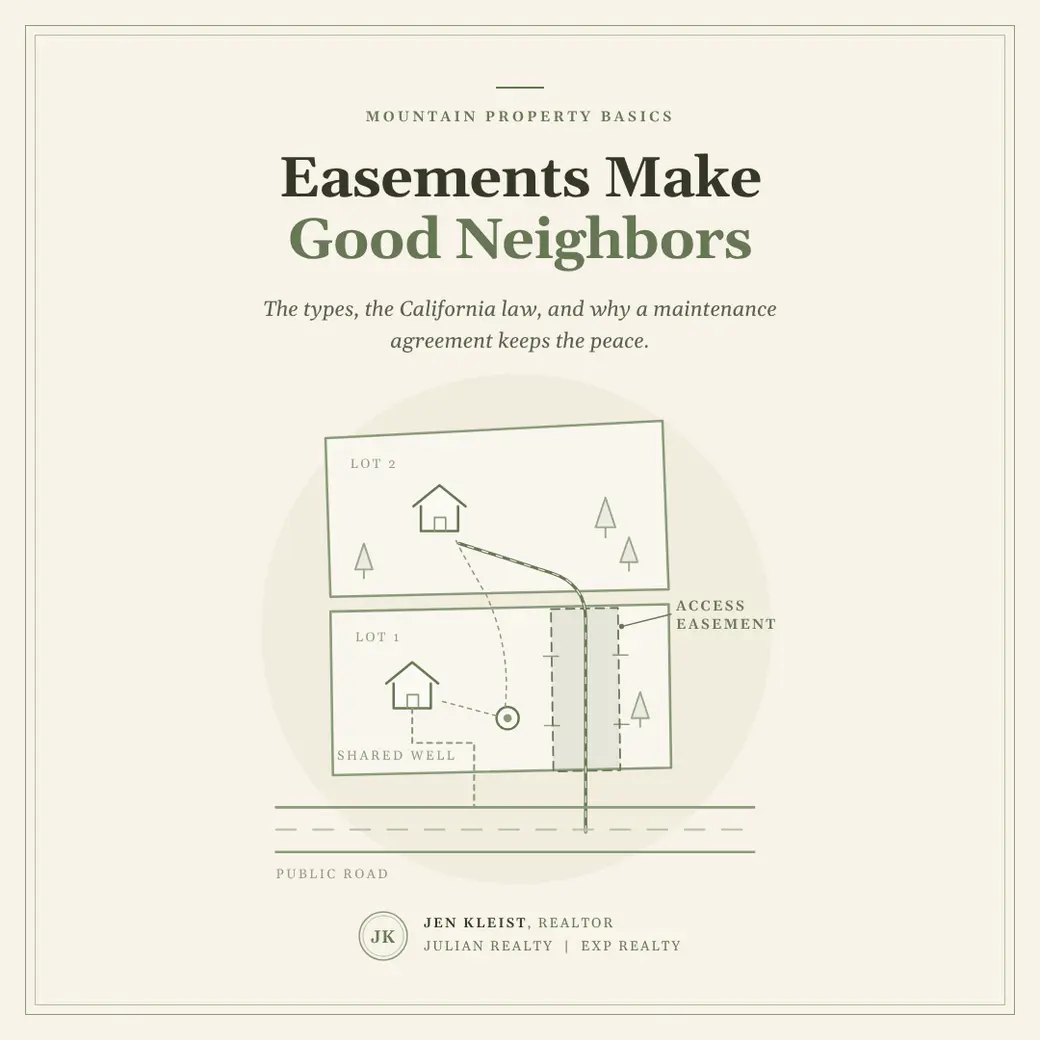
Easements Make Good Neighbors: What Every East County Homeowner Should Know
By Jen Kleist, REALTOR® | Julian Realty | eXp Realty | DRE #02228818 | NMLS #2276965 Serving Julian, Alpine, Descanso, Pine Valley, Guatay, and the East County San Diego mountain communities 619-985-3618 | jenkleist@gmail.com | jenkleist.com
Robert Frost's neighbor famously said "good fences make good neighbors." Out here in the mountains, where a lot of us share a dirt road, a driveway, or a well line that crosses somebody else's land, I'd like to offer an update: good easements make good neighbors. And a good maintenance agreement? That keeps them talking to each other.
As a REALTOR® in East County San Diego who has spent most of my life in these mountain communities, and more than 20 years in banking, lending, and property management before that, I can tell you easements come up in rural transactions all the time. Most are completely routine. A few can surprise a buyer if nobody explains them early. So let's talk about what an easement is, the common types, and why understanding them (and the laws behind them) matters before you buy or sell.
What Is an Easement?
An easement is a legal right to use someone else's property for a specific purpose. The owner still owns the land, but another person, property, or company has permission to use part of it in a defined way.
A few everyday examples:
- Your neighbor's only road access crosses the corner of your parcel.
- SDG&E has the right to run and maintain power lines along your property line.
- Your shared well sits on one lot, with water lines running to three homes.
- A septic leach field or drainage path crosses a boundary.
The key idea is that an easement is a right to use, not a right to own. It usually stays with the property when it sells, which is exactly why buyers need to know about it.
Two Big Categories
Before we get into how easements are created, it helps to know the two main categories.
Easement appurtenant. This easement benefits a piece of land, not a specific person. The property that benefits is called the dominant parcel, and the property that carries the burden is the servient parcel. When either property sells, the easement goes with it. Shared road and driveway access easements are usually this type.
Easement in gross. This one benefits a person or a company rather than a neighboring parcel. Utility easements are the most common example. The utility company holds the right, no matter who owns the land.
Common Types of Easements
Express Easements
These are created on purpose, in writing, and are usually recorded with the County Recorder. They show up in the deed, a separate recorded easement document, or a subdivision map. Express easements are the cleanest kind because the location, width, and purpose are typically spelled out.
Utility Easements
Power, phone, cable, water, and gas companies often hold recorded easements to install and maintain their lines and equipment. On rural properties, these can affect where you place a fence, an ADU, a shop, or even certain landscaping.
Access Easements (Ingress and Egress)
This is the big one in the mountains. Many properties in Julian, Alpine, Descanso, Pine Valley, and Guatay are reached by private roads or shared driveways that cross other parcels. An access easement gives the right to travel over that land to reach your home.
Implied Easements
Sometimes an easement is never written down but is still recognized by the law. In California, an implied easement can arise when a larger property is divided and one part had been clearly and continuously used to serve another part before the split. Think of a driveway everyone has always used, or a water line that was already in place when the land was divided.
Easements by Necessity
If a parcel was split off and left with no legal access at all (landlocked), a court may recognize an easement by necessity across the land it was originally part of. These generally last only as long as the necessity exists. If another legal access route becomes available, the easement may end.
Prescriptive Easements
This is the one that tends to surprise people. In California, someone can gain an easement over another person's land through long-term use, without permission. Generally, the use must be open and visible, continuous and uninterrupted for five years, and done without the owner's permission. A neighbor who has driven across a corner of your lot for years could potentially claim a prescriptive easement.
Unlike adverse possession, a prescriptive easement does not transfer ownership of the land, and it does not require paying property taxes on it. Because prescriptive easements are not recorded, they will not appear on a title report, which is one reason walking the property and talking with neighbors matters.
Conservation Easements
Some landowners voluntarily place conservation easements on their property, often with a land trust or public agency, to limit future development and protect open space or habitat. These can come with tax benefits for the owner, but they also restrict what future owners can build.
Why Knowing the Difference Matters
Here's the practical side. The type of easement affects:
What you can build and where. A recorded utility or access easement can limit where an ADU, garage, barn, or fence can go. It is much better to learn that during escrow than after you've hired a contractor.
Your financing. Lenders care about legal access. If a home sits on a private road, many loan programs want to confirm there is a recorded access easement and a plan for who maintains the road. With my lending background, this is one of the first things I look at, because it can affect a buyer's loan approval and timeline.
Your title insurance. Recorded easements appear as exceptions in the preliminary title report. Unrecorded ones (like prescriptive or some implied easements) won't. Reviewing the prelim carefully, asking about survey options, and walking the land together all help fill in the picture.
Whether an easement can end. Not every easement lasts forever. An easement can end when the same person comes to own both properties, when the holder formally releases it, or when it is truly abandoned. In California, simply not using a recorded express easement usually does not end it on its own. A prescriptive easement, on the other hand, can be lost through five years of nonuse. The details matter.
Your relationship with your neighbors. Most easement disputes are not really about law. They are about expectations. Clear documents make for clear expectations.
The Maintenance Agreement: The Real Neighbor Saver
If you share a road, driveway, or well, a maintenance agreement is where the good neighbor magic happens.
A road or shared use maintenance agreement is a written (ideally recorded) document that spells out:
- Who is responsible for repairs and upkeep
- How costs are divided (equally, by parcel, by frontage, or by usage)
- How decisions get made and how work gets approved
- How to handle damage caused by one owner, such as heavy equipment during construction
- What happens when an owner doesn't pay their share
- Snow, grading, drainage, and brush clearing responsibilities
What does California law say if there is no agreement? California Civil Code Section 845 provides that the owners who use an easement are responsible for maintaining it, and when there is no written agreement, the cost is generally shared in proportion to each owner's use. If someone refuses to contribute, the other owners can seek help through the courts, including small claims when the amount qualifies. That's a helpful backstop, but it's no substitute for a clear agreement everyone has already signed. Nobody wants to take their neighbor to small claims over a load of road base.
For shared wells, a separate shared well agreement works the same way, covering pump replacement, electrical costs, water testing, and access to the well site. If you're buying a home with a shared well or septic crossing a boundary, ask for these documents early.
Tips for Buyers and Sellers
For buyers:
- Read the preliminary title report and ask about every easement listed.
- Ask whether the property is on a private road and whether a road maintenance agreement exists.
- Walk the property and look for paths, tire tracks, utility lines, or pipes that might suggest an unrecorded use.
- Talk with your lender early if the home has shared or private access.
For sellers:
- Gather any recorded easements, maintenance agreements, and shared well documents before you list.
- Disclose known easements and any shared features like driveways, roads, or wells.
- If there has never been a written maintenance agreement, consider working with your neighbors to create one. It can make your home easier to finance and sell.
The Bottom Line
Easements are a normal part of mountain living. They're how we get to our homes, get power to the house, and share water with the family down the road. When everyone understands the type of easement they're dealing with, and there's a clear maintenance agreement in place, neighbors tend to stay friendly and transactions tend to go smoothly.
This post is for general educational purposes and is not legal advice. For questions about a specific easement or a dispute, please consult a California real estate attorney or your title company.
Have Questions About Easements on a Mountain Property?
Whether you're buying on a private road in Julian, selling a home with a shared well in Descanso, or just trying to figure out what that line on your title report means, I'm happy to help you sort it out.
Jen Kleist, REALTOR® Julian Realty | eXp Realty | DRE #02228818 | NMLS #2276965 2127 Main St, Julian, CA 92036 619-985-3618 | jenkleist@gmail.com jenkleist.com | Schedule a 30-minute call
Categories
Recent Posts



GET MORE INFORMATION